Technology
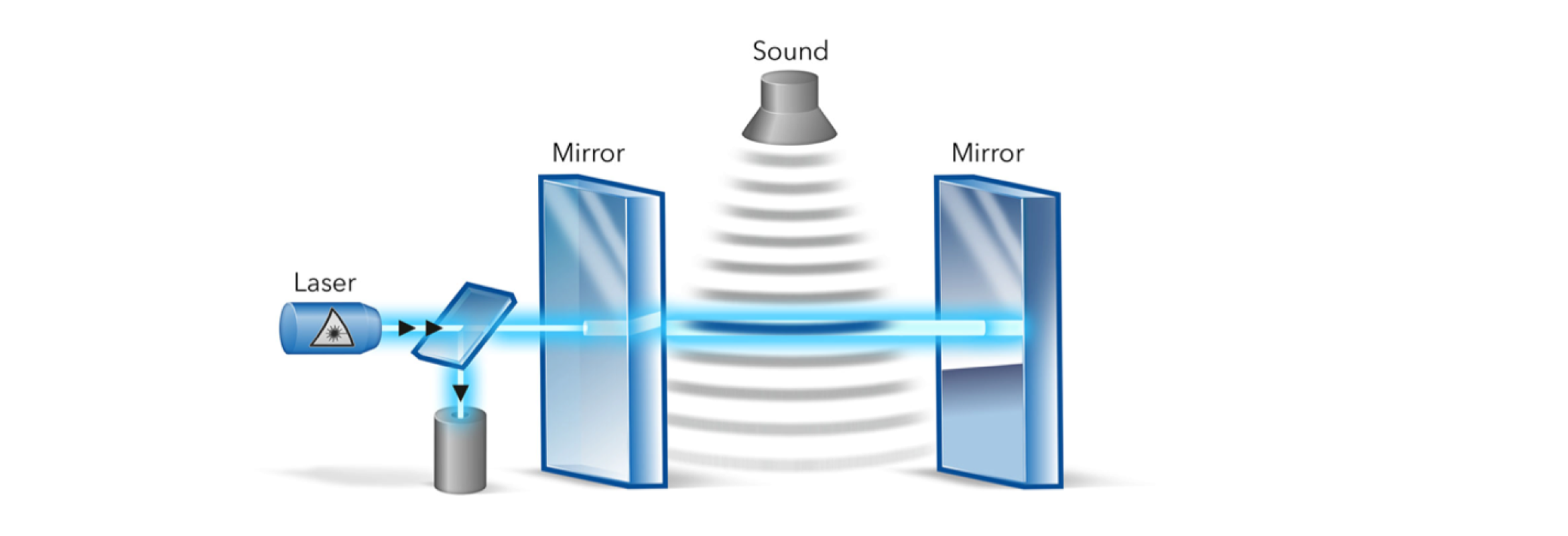
Acoustic ultrasonic sensors with piezoelectric crystals rely on mechanical vibrations induced by sound waves to deform the crystal. The patented technology of the Optical Microphone takes a completely different approach: instead of mechanical vibrations, it utilizes the effect of sound on the speed of light.
In a rigid Fabry-Pérot laser interferometer, consisting of two miniaturized mirrors, the sound pressure changes the refractive index of the air. This alters the optical wavelength and the light transmission which consequently leads to the respective electrical signal. In contrast to conventional microphones, the Optical Microphone is the world's first microphone without any moving parts. No mechanically movable or physically deformable parts are involved. By consequence, the sensors exhibit a compelling frequency bandwidth, free from mechanical resonances. The sensor principle is highly sensitive. In fact, refractive index changes below 10-14 can be detected with this technology. This corresponds to pressure changes as small as 1 µPa.
Wikipedia: Microphone – Fabry–Pérot interferometer-based microphones
Advantages
XARION’s patent-protected sensor technology platform offers substantial advantages:
- Extreme ultrasound frequency range from 10 Hz up to 4 MHz in air, 20 MHz in liquids
- Acoustic and ultrasound detection greater by a factor of 10 than present state-of-the art
- Transducer principle with a perfectly linear frequency response. Although the enclosure needs to be carefully designed to minimize its influence on the sound field, the transducer itself is not frequency dependent
- Sound detection in air and liquids
- Qualification for ultra-high sound pressure levels (up to 190 dB SPL)
- Since no moving inert mass is involved, the Optical Microphone has a true temporal impulse response.
- Inherent phase match in array configurations
- No metallic parts and glass fiber-coupled, hence operational in high electromagnetic fields.
Research & Development
To explore and leverage novel sensing approaches enabled by the membrane-free optical microphone technology, XARION pursues a number of national and international research collaborations.
The optical microphone technology is protected by several patents, including patents granted in the United States, the European Union, China, South Korea, Japan, and other countries. The company’s scientific advisory board is headed by T.W. Hänsch, Nobel laureate and laser physicist.
References
B. Fischer, Nature Photonics 10, 356–358 (2016)
M. Brauns et al., Materials Evaluation 79 (1), 28–37 (2021)